In most capitals, the main attractions are monuments, museums, or historic districts.
In Nouakchott, the real spectacle takes place on the beach.
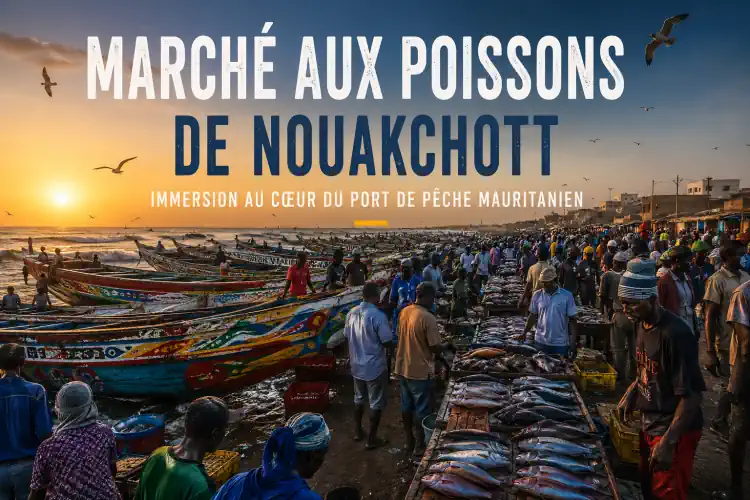
Every morning, hundreds of colorful fishing boats emerge from the Atlantic and head toward the shore. As the pirogues approach the sand, crowds gather to welcome the fishermen returning from the sea.
The Nouakchott Fish Market is not just a market.
It is one of the most fascinating cultural experiences in Mauritania.
A Living Theater on the Atlantic Coast
Unlike modern commercial harbors, Nouakchott’s artisanal fishing port operates directly from the beach.
There are no large docks or container terminals.
Instead, fishermen launch and land their boats through the waves, often relying on teamwork and experience to navigate the surf.
When the pirogues arrive, dozens of workers rush into action.
Fish are unloaded, sorted, weighed, and transported across the sand while traders negotiate prices and seagulls circle overhead.
The atmosphere is intense, noisy, and completely authentic.
The Famous Colorful Pirogues of Nouakchott
One of the most striking sights is the fleet of traditional wooden pirogues.
Painted in bright shades of blue, yellow, green, red, and orange, these boats create an extraordinary contrast against the beige sand and deep blue Atlantic Ocean.
Many are decorated with symbols, religious inscriptions, or personal artwork.
For photographers, this is undoubtedly one of the most visually rewarding locations in Mauritania.
The best light usually occurs shortly after sunrise or during the late afternoon golden hour.
A Glimpse Into Daily Life in Mauritania
The fish market offers far more than beautiful photographs.
It provides a rare opportunity to observe everyday life in Nouakchott.
Fishermen repair nets beside their boats. Vendors prepare fresh fish for customers. Porters transport heavy baskets across the beach while buyers inspect the day’s catch.
The market reflects the economic importance of artisanal fishing in Mauritania and the close relationship between the country and the Atlantic Ocean.
A Meeting Point of Cultures
Nouakchott’s fishing port brings together communities from across West Africa.
Languages such as Hassaniya Arabic, Wolof, Pulaar, Soninké, and Bambara can often be heard throughout the market.
Many fishermen come from neighboring Senegal, while traders arrive from different regions of Mauritania.
This diversity creates a unique atmosphere where Saharan traditions meet Atlantic maritime culture.
Why Visit the Nouakchott Fish Market?
Because it reveals a side of Mauritania that many travelers never expect.
While destinations such as Chinguetti, Ouadane, and the Sahara Desert attract most visitors, the fish market showcases another face of the country—dynamic, coastal, multicultural, and deeply connected to the sea.
For travelers interested in photography, culture, or authentic experiences, it is one of the most memorable places to visit in Nouakchott.
Practical Information
Best time to visit: Early morning or late afternoon.
Photography: Always ask permission before taking close-up portraits.
Footwear: Closed shoes are recommended as the beach can be wet and crowded.
Duration: Allow at least one hour to explore the market and observe the arrival of the boats.
Explore Nouakchott Beyond the Fish Market
The fish market is only one part of the city.
To discover local markets, beaches, cultural sites, and practical travel tips, see our complete guide:
👉 Visit Nouakchott: The Complete Travel Guide